

MIR Organization and Chain of Command
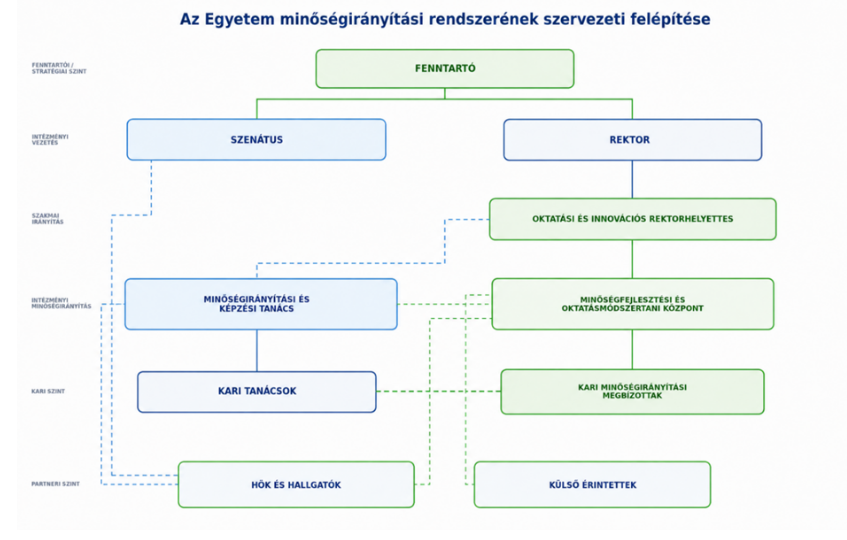
Quality management is a shared responsibility at the institutional level, in which oversight, decision-making, operational coordination, and departmental implementation are carried out in a coordinated manner.
Senate: The highest regulatory and decision-making body for quality management. It approves the MIR Manual, discusses quality policy and annual quality objectives, adopts the annual quality improvement report, and monitors compliance with external accreditation requirements.
Rector: Oversees the operation of MIR at the strategic level, is responsible for ensuring the implementation of the quality policy, secures the necessary resources, promulgates the current handbook via a rector’s directive, and approves the annual institutional quality objectives.
Vice Rector for Education and Innovation: The institutional professional leader of educational processes and quality improvement. As chair, leads the Quality Management and Education Council, oversees the Center for Quality Improvement and Educational Methodology, and approves MIR forms and records.
Quality Management and Training Council: The university’s professional, evaluative, and decision-preparatory body. It regularly analyzes measurement data (OMHV, satisfaction, dropout rates), reviews compliance with MAB/ESG standards, provides feedback on self-evaluation and accreditation documents, and initiates development measures. Members: the rector, vice rectors, the director of strategy, deans, the head of the Center for Quality Improvement and Teaching Methodology, and a representative of the Student Union.
Center for Quality Development and Teaching Methodology: The operational engine of MIR, it maintains MIR documentation and central records, organizes self-evaluations and OMHV surveys, prepares analyses for decision-makers, coordinates preparations for external accreditation, and organizes methodological training for faculty members.
Faculties, Faculty Councils, and Deans: At the faculty level, the Faculty Council makes quality-related decisions, while the dean is responsible for the processes. They prepare an annual faculty report, conduct unit-level self-evaluations, and implement development action plans.
Faculty Quality Management Representatives: They serve as liaisons between the faculties and the Center, coordinate faculty-level assessments, self-evaluations, and reviews, and help embed a culture of quality at the local level.
Student Government and students: They participate in the committees as partners, may propose amendments to the MIR Handbook, contribute to the design of surveys, and provide feedback on educational processes.